Treatments
Missing a Tooth? Dental Implant vs Bridge vs Denture, Compared
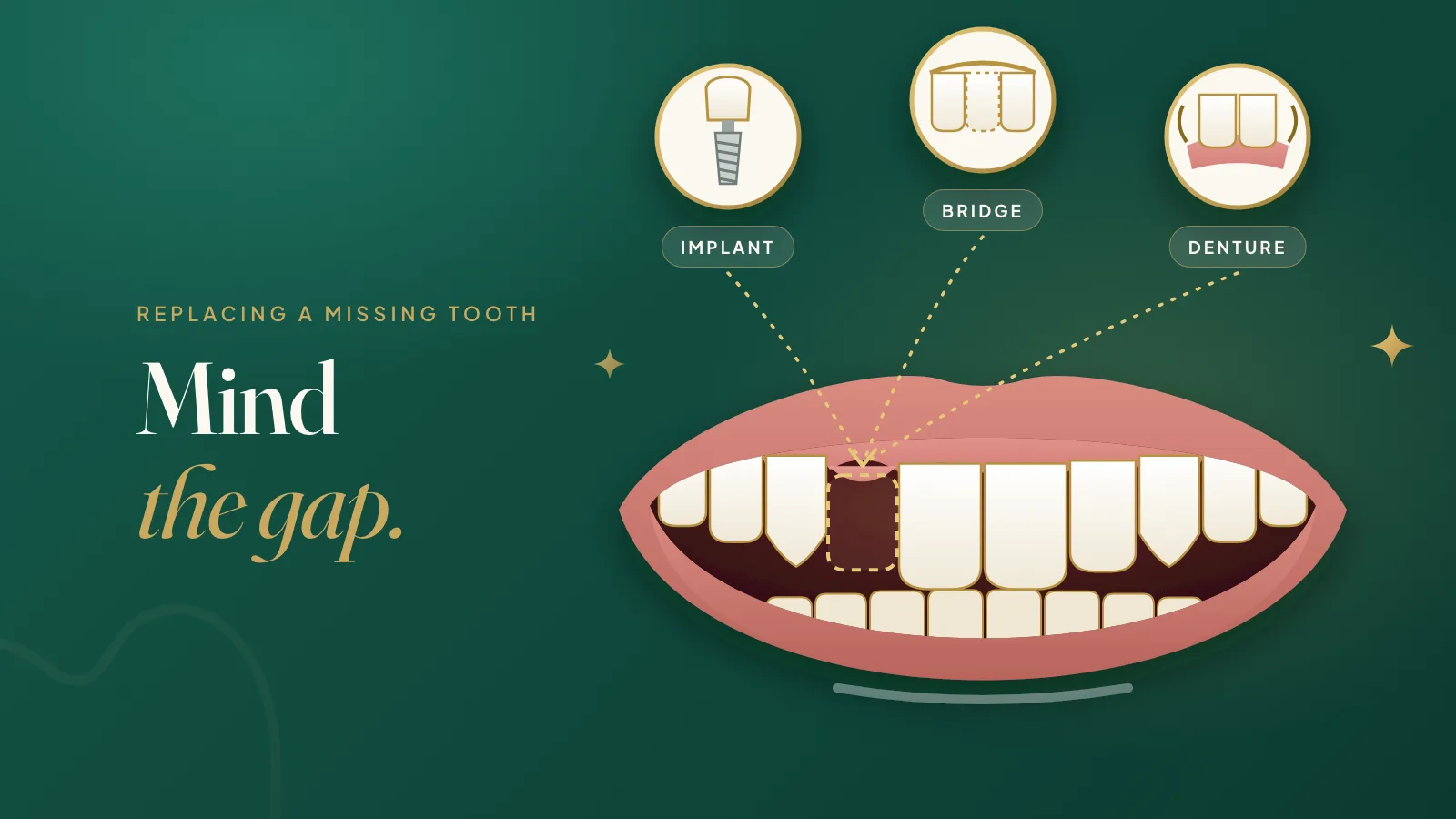
Losing a tooth — to decay, a crack, gum disease or an accident — is more common than most people think, and so is putting off deciding what to do about it. Part of the reason is that the three main options sound confusingly similar.
This guide lays them side by side in plain language: what a dental implant, a bridge and a denture actually are, how long each takes, how long each lasts, and who each one tends to suit. It's the same conversation we have with patients every week at our clinic in Kothanur.
The three options in one sentence each
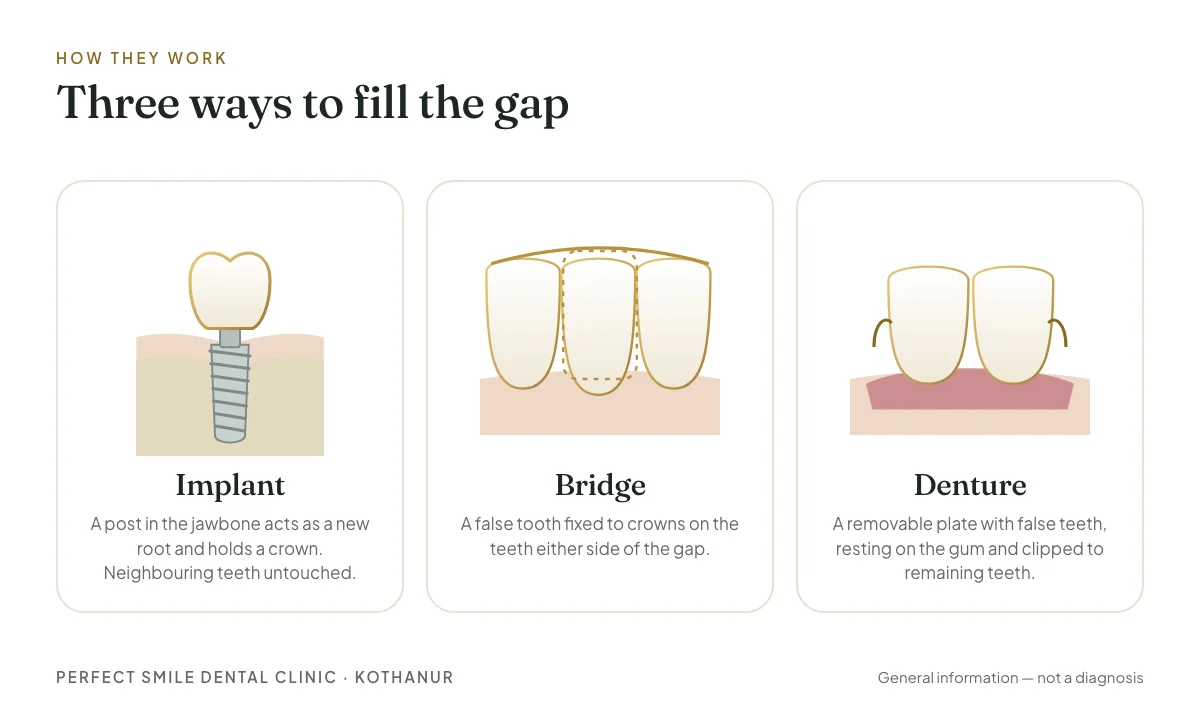
- Dental implant: a small titanium post placed in the jawbone that acts as a new root, topped with a crown that looks like a natural tooth.
- Bridge: a fixed false tooth held in place by crowns on the teeth on either side of the gap.
- Denture: a removable plate carrying one or more false teeth — partial if you still have some natural teeth, full if you don't.
Dental implants: closest to a natural tooth
An implant replaces the root as well as the visible tooth. Over a few months the bone grows tightly around the titanium post — a process called osseointegration — and the crown fitted on top is then firm enough to chew on like a natural tooth.
Why people choose it
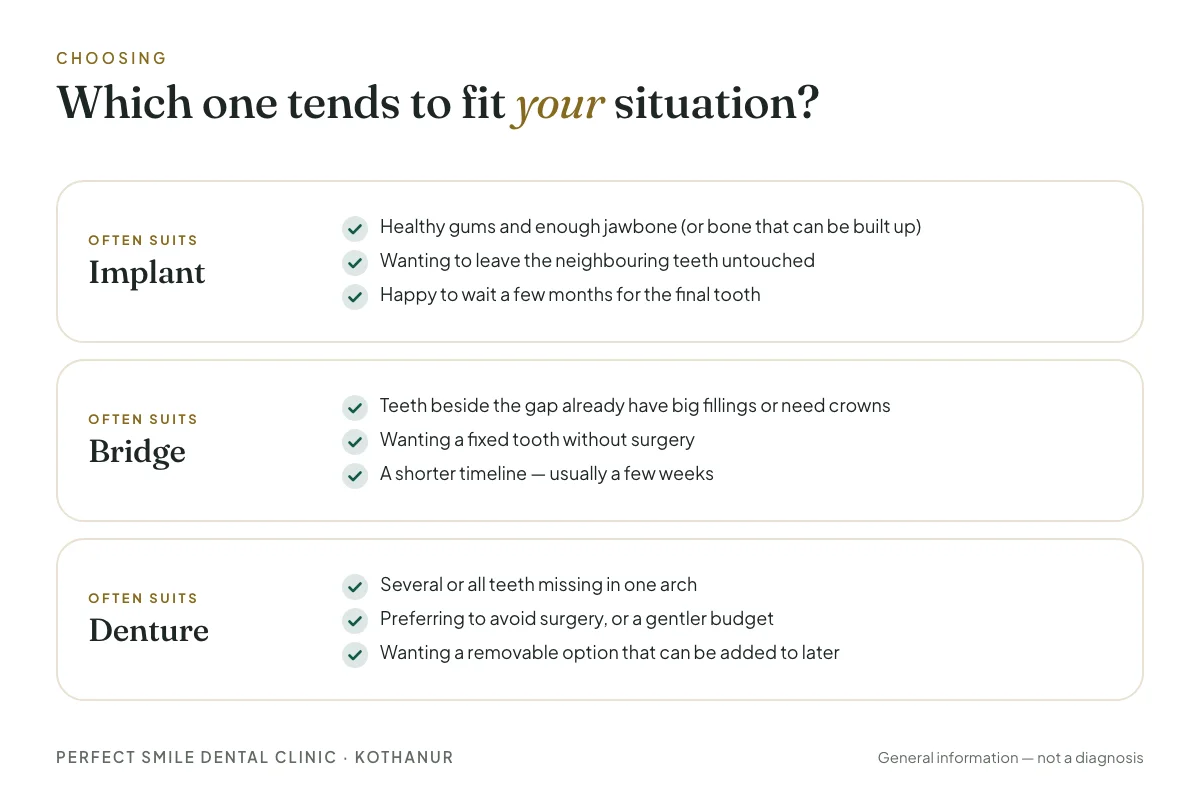
- The teeth either side of the gap are left untouched.
- It stimulates the jawbone, which helps slow the bone shrinkage that follows tooth loss.
- It's fixed — nothing to take out at night — and can also anchor a bridge or stabilise a loose denture when several teeth are missing.
What to weigh up
- It involves a minor surgical procedure under local anaesthetic.
- It takes longer: usually a few months from placement to the final crown, longer if bone needs building up first.
- It needs healthy gums and enough bone. Smoking, uncontrolled diabetes and gum disease raise the risk of problems, so we'll talk these through honestly.
You can read how we plan and place dental implants on our treatments page.
Bridges: fixed and faster
A bridge "bridges" the gap with a false tooth that's joined to crowns on the neighbouring teeth. Those neighbouring teeth are trimmed down so the crowns can sit over them.
Why people choose it
- No surgery, and it's usually finished in a couple of visits over a few weeks.
- It's fixed in place and feels solid when you bite.
- It makes particular sense when the teeth beside the gap already have large fillings or need crowns anyway.
What to weigh up
- Healthy neighbouring teeth have to be reshaped, which can't be undone.
- Cleaning under the false tooth takes a little extra effort (a floss threader or interdental brush).
- The bridge is only as strong as the teeth holding it up — decay or gum disease in those teeth can affect the whole bridge.
Dentures: flexible and least invasive
Modern dentures are custom-made to fit your mouth, with teeth chosen to suit your face. A partial denture clips around your remaining teeth; a full denture rests on the gums and is held by a close fit and suction.
Why people choose it
- Can replace one tooth, several, or a whole arch in a single appliance.
- No surgery and little or no change to your other teeth.
- Usually the quickest and most budget-friendly option, and easy to add teeth to later.
What to weigh up
- Removable — you take it out to clean it and usually overnight.
- It takes a few weeks to get used to eating and speaking with it.
- Because it doesn't replace the root, the bone under it slowly shrinks, so dentures need relining or remaking over the years. Lower full dentures in particular can feel loose — two or more implants can be added to hold them firmly.
Side by side
| Implant | Bridge | Denture | |
|---|---|---|---|
| Fixed or removable | Fixed | Fixed | Removable |
| Affects neighbouring teeth | No | Yes — they're crowned | Minimal (clasps rest on them) |
| Surgery needed | Yes, minor | No | No |
| Typical time to finish | A few months | A few weeks | A few weeks |
| Helps preserve jawbone | Yes | No | No |
| Cleaning | Brush and floss like a tooth | Clean under the false tooth | Take out and clean daily |
| Best for | One or more teeth, healthy gums & bone | One or two teeth next to crowned/filled teeth | Several or all teeth, or avoiding surgery |
These are general patterns. Your own X-rays and gum health decide what's realistic.
What happens if you leave the gap?
It's tempting to leave a back-tooth gap that nobody can see. Sometimes that's a reasonable choice — but it's worth knowing what tends to happen over the years:
- The teeth beside the gap can tip or drift into the space.
- The tooth above or below can over-erupt because it has nothing to bite against.
- The jawbone shrinks where the root used to be, which can make an implant harder later without a bone graft.
- Chewing shifts to the other side, and your bite can change.
If a tooth needs to come out, it's worth planning the replacement before the extraction — sometimes an implant can be placed at the same visit or soon after.
How we help you choose

A replacement plan at Perfect Smile usually looks like this:
- Examination and X-rays (or a 3D scan for implants) to check the gap, the bone and the neighbouring teeth.
- Fixing anything urgent first — gum disease, decay or an infected tooth — because any replacement is only as healthy as the mouth around it.
- Options side by side, with honest pros, cons, timelines and costs for each.
- Treatment at your pace, with temporary teeth where needed so you're never left with a visible gap.
Dr. Shilpa holds a diploma in implants and works alongside our implantologist, and our crowns, bridges and dentures are custom-made to match your smile.
Ready to talk through your options?
A missing tooth rarely gets easier to fix with time. Message us to book a consultation — we're in Kothanur, an easy drive from Hennur, Kalyan Nagar, HRBR Layout and Byrathi. And if the tooth is still there but aching, read what to expect from a root canal — it may well be savable.
Quick answers
Frequently asked questions
What is the best way to replace a missing tooth?
It depends on your mouth. Implants are often the closest thing to a natural tooth and don't involve the neighbouring teeth, but they need healthy gums, enough bone and a few months of healing. A bridge is a good fixed option, especially if the teeth on either side already need crowns. A denture is removable and suits people missing several teeth or who'd rather avoid surgery. Your dentist will explain which options are realistic after an examination and X-rays.
Is a dental implant better than a bridge?
Not always — they suit different situations. An implant stands on its own, so the teeth beside the gap aren't reshaped, and it helps keep the jawbone in that area. A bridge is usually faster, needs no surgery, and can be the sensible choice when the neighbouring teeth already have large fillings or need crowns anyway.
How long do implants, bridges and dentures last?
With good care and regular check-ups, implants can last many years, often decades, though the crown on top may need replacing through wear. Bridges commonly last many years too, depending on the health of the supporting teeth. Dentures usually need relining or remaking every several years because the gums and bone underneath change shape over time.
What happens if I don't replace a missing tooth?
Over time the teeth next to the gap can tip or drift into the space, the opposing tooth can over-erupt, and your bite can change. The jawbone where the tooth was also slowly shrinks. Gaps can make chewing harder and, for front teeth, affect your smile and confidence. Not every gap must be filled, but it's worth discussing with your dentist.
Is getting a dental implant painful?
The area is numbed with local anaesthetic, so placing the implant shouldn't hurt — most people feel pressure rather than pain. Some soreness and swelling for a few days afterwards is normal and is usually managed with the aftercare and pain relief your dentist advises.
Can I get an implant years after losing a tooth?
Often, yes. The main question is whether there's enough healthy bone left to hold the implant. If bone has shrunk, it can sometimes be built up first with a bone graft. A 3D scan or X-ray shows what's possible.
How much does a dental implant, bridge or denture cost in Bengaluru?
Costs vary widely with the number of teeth being replaced, materials, whether bone grafting or extractions are needed and what the implant supports, so a fair figure can only be given after an examination. At Perfect Smile we lay out the options and their costs side by side before any treatment begins, so you can choose with no surprises.
Sources & further reading
- American Dental Association (MouthHealthy) — Missing teeth
- American Dental Association (MouthHealthy) — Dental implants
- American Dental Association (MouthHealthy) — Bridges
- NHS — Dentures (false teeth)
This article is general information, not a diagnosis or a substitute for a dental examination. Every mouth is different — please see a dentist about your own situation.
Come and see us in Kothanur
Book a visit with Dr. Shilpa and the team — we’ll take a look, explain what we find in plain language, and talk you through your options. No pressure.
Keep reading
All articles Treatments
Braces vs Invisalign for Adults: Which Is Right for You?
Thinking about straightening your teeth as an adult? An honest, side-by-side look at fixed braces and clear aligners — how they work, how long they take and who each suits.
Read article Treatments
Is a Root Canal Painful? What to Expect, Step by Step
The honest answer to the question every patient asks — plus what actually happens in the chair, how long it takes, and what recovery feels like.
Read article